What Does It Cost to Rebuild a House? A Complete 2026 Breakdown
Rebuilding a house after a total loss costs $150,000–$800,000+ depending on size, construction, and location. Here's a full cost breakdown by trade so you know what your insurer is paying for.
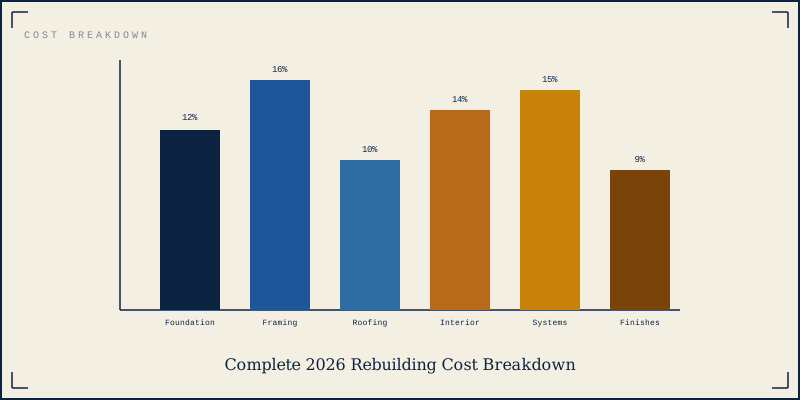
Quick Answer
Rebuilding a standard 2,000 sq ft wood-frame home in an average-cost U.S. market costs $420,000–$480,000 in 2026, including contractor overhead. High-cost markets (California, Northeast) push that same home to $650,000–$850,000. Here's exactly where the money goes.
Why You Need to Understand Rebuild Costs
Most homeowners never think about what it would actually cost to rebuild their home until the moment they have to. By then, it's too late to adjust your coverage.
Understanding how rebuild costs are composed helps you in three ways: it helps you verify your insurance calculator's estimate makes sense, it helps you explain to your insurer why your requested coverage limit is justified, and it helps you understand what's at stake if you're underinsured.
Here's a complete trade-by-trade breakdown of where the money goes in a total home rebuild.
Phase 1: Site Preparation and Foundation (8–12% of total cost)
Before a single wall goes up, the debris has to come out. After a total loss, particularly after a fire, demolition and debris removal alone costs $15,000–$40,000 for a typical home. This is usually a covered expense under your policy's "removal of debris" provision, but limits apply (typically $10,000–$25,000; verify yours).
Foundation: Poured concrete slab foundations run $8–$14/sq ft. Crawl space foundations run $10–$16/sq ft. Full basements are the most expensive at $20–$40/sq ft of basement area, due to excavation, waterproofing, and concrete work. Foundation type and soil conditions affect this cost significantly.
For a 2,000 sq ft home with a slab: $16,000–$28,000 in foundation costs alone.
Phase 2: Framing (15–20% of total cost)
The structural skeleton of the home (floor joists, wall studs, roof rafters, engineered beams, and sheathing) runs $25–$40 per square foot of living area for wood-frame construction.
Lumber prices are volatile. At the peak of the 2021 lumber shortage, framing lumber had tripled in price from pre-pandemic levels. Prices have moderated since but remain above 2019 levels. Framing a 2,000 sq ft home typically costs $55,000–$85,000 in materials and labor combined.
Story complexity matters here. A two-story home requires more structural complexity (staircase framing, load-bearing walls on the upper level, and longer mechanical runs), adding roughly 15% to framing costs per square foot versus a single-story footprint of the same total area.
Phase 3: Roofing (8–12% of total cost)
Roofing runs $8–$18 per square foot of roof surface area (which is larger than floor area because of roof pitch). An architectural asphalt shingle roof on a typical home runs $15,000–$25,000. A metal roof costs $25,000–$50,000 for the same footprint. Tile roofs run $35,000–$70,000.
Post-disaster roofing costs spike dramatically. After a regional hailstorm or hurricane event, local roofing contractors book out 6–12 months in advance, and rates increase 20–40%. Your insurer's adjuster will price your claim at market rates at the time of the loss, which is why post-disaster claims often cost more than pre-disaster estimates.
Phase 4: Exterior Envelope (10–14% of total cost)
Windows, doors, exterior siding or cladding, and weatherproofing combine to form the thermal envelope of the home.
- —Windows: Standard double-pane vinyl windows run $300–$600 each installed. A 2,000 sq ft home typically has 15–25 windows. Total: $5,000–$15,000 for standard quality; $15,000–$40,000 for premium windows.
- —Exterior siding: Vinyl siding runs $5–$8/sq ft installed. Fiber cement (Hardie board) runs $10–$16/sq ft. Brick or stone veneer runs $18–$35/sq ft. For a 2,000 sq ft home with typical exterior wall area: $18,000–$55,000 depending on material.
- —Entry doors: Standard exterior doors run $1,000–$2,500 installed. Fiberglass or steel entry systems with sidelights run $2,500–$6,000.
Phase 5: Mechanical Systems (15–22% of total cost)
Plumbing, electrical, and HVAC are the three critical mechanical systems that account for a disproportionate share of rebuild cost per square foot.
Plumbing: Complete plumbing installation (supply lines, drain/waste/vent, fixtures) runs $12,000–$25,000 for a 2,000 sq ft home. Homes with multiple bathrooms, wet bars, or complex kitchen plumbing are at the higher end.
Electrical: Full electrical installation (panel, wiring, outlets, switches, fixtures) runs $8,000–$20,000 for a 2,000 sq ft home. Homes in jurisdictions requiring arc-fault interrupters (AFCI) and whole-home surge protection face higher electrical code requirements.
HVAC: A complete heating and cooling system (air handler, compressor, ductwork, thermostats) runs $10,000–$20,000 for a standard single-zone system. Multi-zone or high-efficiency systems run $20,000–$45,000.
Note on code upgrades: Electrical and mechanical codes change every 2–3 years. Rebuilding your home may require upgrades beyond what you originally had: AFCI breakers, updated plumbing materials, higher-efficiency HVAC equipment. This is exactly what the "code upgrade" or "ordinance and law" coverage in your policy addresses. Verify your policy includes this.
Phase 6: Insulation and Drywall (6–8% of total cost)
Insulation (blown-in fiberglass, batt insulation, spray foam) runs $3,000–$8,000 for a typical home. Drywall installation (hanging, taping, mudding, and priming) runs $2–$4/sq ft of wall and ceiling surface, totaling $8,000–$18,000 for most homes.
Phase 7: Interior Finishes (20–28% of total cost)
This is where quality grade has the biggest impact. Economy finishes cost a fraction of luxury finishes, and this phase accounts for 20–28% of the entire project.
- —Flooring: Vinyl/LVP runs $3–$6/sq ft installed; hardwood runs $8–$15/sq ft; tile runs $6–$14/sq ft.
- —Kitchen cabinets and countertops: Stock cabinets + laminate counters run $8,000–$15,000. Semi-custom cabinets + quartz counters run $20,000–$40,000. Full custom + marble or quartzite runs $50,000–$100,000+.
- —Interior doors: Hollow-core standard doors run $150–$300 each installed. Solid wood doors run $400–$900 each.
- —Painting: Interior painting runs $1.50–$3.50/sq ft, or $3,000–$7,000 for most homes.
For a full quality grade comparison, see our economy vs. standard vs. luxury construction costs.
Phase 8: Contractor Overhead and Profit (15–20% of total)
This is the component many homeowners overlook. General contractors don't build homes for free. They charge 15–20% of the project cost for overhead (insurance, workers comp, supervision, office costs) and profit. This markup is legitimate and expected. Any replacement cost estimate that doesn't include it is understating the actual claim.
For a $400,000 construction cost project, contractor O&P adds $60,000–$80,000, bringing the total to $460,000–$480,000.
Complete Cost Summary for a 2,000 Sq Ft Home (Standard Quality, National Average)
| Phase | Cost Range |
|---|---|
| Site prep and foundation | $31,000–$56,000 |
| Framing | $55,000–$85,000 |
| Roofing | $15,000–$25,000 |
| Exterior envelope | $18,000–$55,000 |
| Mechanical systems | $30,000–$65,000 |
| Insulation and drywall | $11,000–$26,000 |
| Interior finishes | $60,000–$105,000 |
| Subtotal | $220,000–$417,000 |
| Contractor O&P (18%) | $40,000–$75,000 |
| Total (before location factor) | $260,000–$492,000 |
| Location factor (1.0× average) | 1.0× |
| Final estimate | $260,000–$492,000 |
The wide range reflects quality grade variation. For a standard-quality home, the estimate narrows to $360,000–$460,000 nationally. Use our home replacement cost calculator to apply your specific quality grade, construction type, and location.
This breakdown shows why rebuild costs are so much higher than most homeowners expect, and why a coverage gap is so dangerous. Check your dwelling limit against your actual replacement cost, and update it if you find a gap.