The Hidden Risk of Being Underinsured: What Happens After a Total Loss
A 2022 CoreLogic study found 69% of U.S. homes are underinsured by an average of 20%. Here's what underinsurance actually costs you after a total loss, and how to fix it now.
Quick Answer
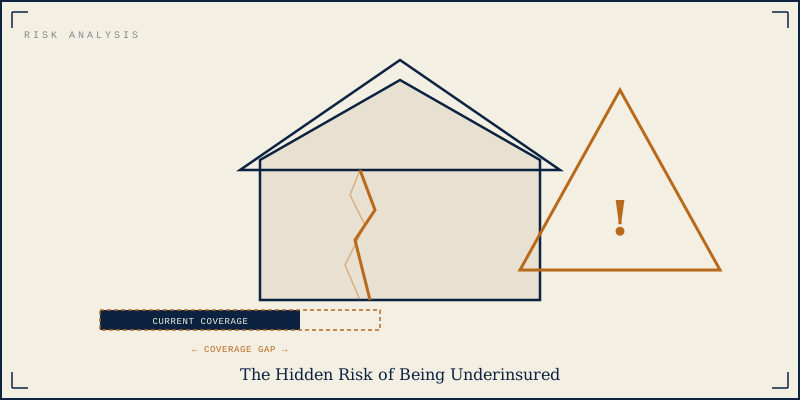
If your home is underinsured, your insurer pays only up to your dwelling coverage limit after a total loss, even if rebuilding costs more. A 20% coverage gap on a $500,000 replacement cost home means you personally cover $100,000. You can fix this by calculating your current replacement cost and adjusting your dwelling limit to match.
The Number Most Homeowners Don't Check
When was the last time you compared your dwelling coverage limit to what it would actually cost to rebuild your home?
If the answer is "never" or "when I bought the house," you're in the majority. And you're likely underinsured.
A 2022 study by CoreLogic found that 69% of U.S. homes with homeowners insurance are underinsured, with average coverage gaps of approximately 20% below actual replacement cost. After the 2021 Marshall Fire in Colorado, which destroyed over 1,000 homes, the Colorado Division of Insurance found that the average insured home had a coverage gap of $150,000.
This isn't a niche problem. It's a systemic one, and it costs homeowners billions of dollars after major losses.
What Happens When You Have a Total Loss
Here's how a total loss claim works under a standard HO-3 homeowners policy:
1. Your home is destroyed (fire, tornado, major flood, explosion).
2. Your insurer assigns an adjuster to estimate the cost to rebuild to pre-loss condition.
3. The insurer pays up to your dwelling coverage limit (Coverage A), not more, regardless of what it actually costs.
4. You are personally responsible for any rebuild cost that exceeds your limit.
If your coverage limit is $400,000 and the actual rebuild cost is $520,000, you get $400,000. You cover the remaining $120,000 yourself, whether through savings, a loan, or by rebuilding a smaller home than what you lost.
There's no appeal, no negotiation, no exception. The limit is the limit.
How Coverage Gaps Develop Over Time
Construction cost inflation. Building costs rose 20–40% between 2020 and 2024 due to supply chain disruptions, labor shortages, and material price spikes. A dwelling limit set in 2019 may now cover only 65–75% of actual rebuild costs.
Inflation guard shortfalls. Many policies include an inflation guard endorsement that increases your dwelling limit automatically by 2–4% per year. That helped during normal times, but 2–4% annual increases couldn't keep pace with 8–15% annual construction cost increases in 2021–2022.
Home improvements. Adding a room addition, finishing a basement, renovating a kitchen, or upgrading a bathroom increases your replacement cost. If you didn't update your coverage limit after the improvement, you're carrying a coverage gap equal to the value of the work done.
Purchased underinsured. Some homeowners inherit coverage gaps from the previous owner. Sellers and their agents don't always verify replacement cost at listing. If you bought a home and simply kept the seller's coverage limits, you may have started with a gap.
Real Numbers: What a Coverage Gap Costs
Example 1, 20% gap on a $500,000 home:
- —Replacement cost: $500,000
- —Coverage limit: $400,000 (20% gap)
- —Shortfall after total loss: $100,000 out of pocket
Example 2, 30% gap on a $350,000 home:
- —Replacement cost: $350,000
- —Coverage limit: $245,000 (30% gap)
- —Shortfall: $105,000 out of pocket
Example 3, post-disaster surge pricing adds 25%:
- —Coverage set correctly at: $450,000
- —Actual rebuild cost after regional disaster surge: $562,500
- —Shortfall from surge alone: $112,500
That last scenario is why the standard recommendation is to insure for 110% of replacement cost. The 10% buffer helps absorb surge pricing, inflation during construction, and cost overruns.
The Special Problem of Post-Disaster Rebuilding
When a major disaster strikes (a wildfire burns a neighborhood, a tornado levels a subdivision, a hurricane destroys a coastal community), every homeowner in the affected area files a claim simultaneously. This creates a local construction bottleneck unlike anything in normal times.
Contractors are fully booked 12–18 months in advance. Material prices spike because local demand outstrips supply. Skilled trades (electricians, plumbers, HVAC techs) charge 30–50% above their normal rates because they have more work than they can handle.
In this environment, even a coverage limit that was adequate before the disaster can be insufficient when actual rebuilding begins. The 2017 California wine country fires, the 2021 Marshall Fire, and the 2023 Maui fires all produced widespread reports of homeowners finding their coverage insufficient once contractor quotes came in.
Five Signs You're Underinsured Right Now
1. Your dwelling limit hasn't changed in 3+ years. Construction costs have risen significantly since 2020. Any limit set before 2022 is likely stale.
2. Your limit was based on market value, not replacement cost. These are often very different. See our replacement cost vs. market value guide.
3. You've made renovations without updating your coverage. A new kitchen or bathroom adds $30,000–$80,000 to your replacement cost. So does an addition.
4. Your inflation guard is less than 4% per year. Given recent construction cost trends, 2–3% annual adjustments haven't kept pace.
5. Your calculated replacement cost is more than 10% above your current dwelling limit. Use our replacement cost calculator to find your current number and compare.
How to Close a Coverage Gap
Step 1: Calculate your current replacement cost. Use our home replacement cost calculator to get an estimate based on your home's square footage, construction type, quality, and location.
Step 2: Compare to your current dwelling limit. Find Coverage A on your declarations page (the first page of your policy). If your calculated replacement cost exceeds your current limit by more than 10%, you need to act.
Step 3: Contact your insurance agent or carrier. Request a dwelling limit increase to match your calculated replacement cost plus 10%. This typically costs $10–$30 per month in additional premium for every $100,000 increase in coverage, a small price for closing a six-figure gap.
Step 4: Ask about better endorsements. Two worth considering:
- —Extended replacement cost: Pays 125% or 150% of your dwelling limit if actual rebuild costs exceed the limit
- —Guaranteed replacement cost: No limit; pays whatever it costs to rebuild your home to pre-loss condition
Step 5: Set a calendar reminder to recalculate annually. Read our coverage update guide for a full annual checklist.
What About Actual Cash Value vs. Replacement Cost Value?
Some policies, especially older or lower-cost policies, pay actual cash value (ACV) rather than replacement cost value (RCV). ACV is replacement cost minus depreciation. For a 20-year-old roof that would cost $25,000 to replace, an ACV policy might pay only $10,000 after applying 20 years of depreciation.
Most standard HO-3 policies include replacement cost coverage for the dwelling structure, but verify this with your agent. If your policy pays ACV on the structure, upgrading to RCV coverage is usually worth the additional premium, which runs $50–$200 per year for most homes.
The math is simple: a coverage gap is a hidden liability that sits on your balance sheet until the day you need it. Calculate your replacement cost now and close any gap you find before disaster strikes, not after.