Why Your ZIP Code Changes Your Home Replacement Cost
The same house costs 2.4x more to rebuild in San Francisco than in rural Mississippi. Here's how regional cost factors work and how to choose the right one for your home.
Quick Answer
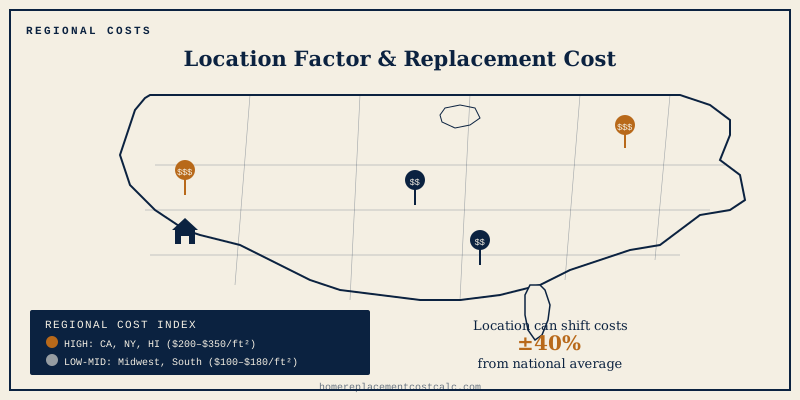
Location factors (also called regional cost indices) multiply your base replacement cost to reflect local labor rates, material costs, and market conditions. They range from 0.75× in rural low-cost areas to 1.80× in high-cost metro areas. Choosing the wrong factor by even 0.2× can shift your replacement cost estimate by $40,000–$80,000 on a typical home.
The Same House, Wildly Different Rebuild Costs
Imagine two identical homes: 2,000 sq ft, wood-frame construction, standard quality, attached 2-car garage. One sits in rural Mississippi. The other sits in San Jose, California.
The Mississippi home costs roughly $342,000 to rebuild. The San Jose home? $709,000. That's a 2.07× difference, for the exact same house.
This gap doesn't reflect the homes' value or what the owners paid. It reflects the reality that lumber costs more to ship to California, union labor rates in the Bay Area are four times higher than in the rural South, and local building codes are stricter. These differences are captured in what's called a location factor or regional cost index.
Getting your location factor right is one of the most important, and most overlooked, inputs in any replacement cost estimate.
What Is a Location Factor?
A location factor is a multiplier applied to the national average base cost per square foot to reflect how local construction costs compare to the U.S. average. A factor of 1.0× means your area's costs match the national average. A factor of 1.4× means it costs 40% more to build in your area than the national norm.
RS Means, the construction cost database used by professional estimators and insurance companies, publishes annual regional cost indices for hundreds of U.S. markets. Marshall & Swift tracks similar data. These indices are built from surveys of actual material prices and labor rates in each market.
Regional Cost Factors by Area
These are approximate ranges based on 2026 RS Means data:
0.65×–0.80× (Below Average / Rural)
Mississippi, Arkansas, rural Alabama, parts of West Virginia, rural Oklahoma and Kansas. Low labor costs, basic code requirements, and abundant local materials keep rebuild costs well below the national average.
0.85×–1.00× (Average / Midwest and South)
Ohio, Indiana, Iowa, Missouri, Tennessee, Georgia, North Carolina, Texas (most markets outside Houston/Austin/Dallas). These markets form the national baseline. Most insurance cost models are calibrated to this range.
1.05×–1.25× (Above Average / Southeast Coast and Growing Markets)
Florida coastal markets, Virginia Beach, Nashville, Denver metro, Phoenix, Charlotte. Growing demand for construction labor has pushed these markets above average in recent years.
1.25×–1.50× (High Cost / Northeast and Mountain)
Boston, New York state outside NYC, Philadelphia, Chicago, Seattle, Portland, Salt Lake City, Colorado resort markets. Combination of union labor, higher material costs, and complex building regulations.
1.50×–1.80× (Very High Cost / Major Metros)
San Francisco Bay Area, Manhattan, Los Angeles metro, Honolulu, Anchorage. The most expensive markets in the country for residential construction. A standard home costs 50–80% more here than in average-cost markets.
What Drives Regional Cost Differences?
Three main factors:
1. Labor rates. A framer in rural Tennessee earns $18–$22/hour. A union framer in Manhattan earns $55–$75/hour including benefits and union dues. Labor typically accounts for 40–50% of residential construction costs, so this difference compounds through every trade.
2. Material costs. Lumber, concrete, and steel are priced nationally, but transportation and regional demand create price variations. In dense urban markets, material storage space is limited and delivery logistics add cost. Post-disaster surges in specific regions can spike material costs 20–40% above normal for 12–18 months.
3. Regulatory requirements. California's Title 24 energy code, New York City's building code, and Hawaii's wind-load requirements all mandate construction specifications above the national minimum. Complying with stricter local codes adds cost. This is also why the 110% recommended coverage buffer includes a "code upgrade" component.
How to Choose the Right Factor for Your Home
Use these steps:
Step 1: Look up your state's typical range from the list above. If you're in a major metro within that state, use the upper end. If you're suburban or rural, use the lower end.
Step 2: Check your county assessor's records for the "cost per square foot" listed on permit valuations in your area. If new home permits are being valued at $175/sq ft and the national average is $185, your factor is approximately 0.95.
Step 3: Ask your insurance agent. Most carriers use a replacement cost estimator tool (Verisk 360Value or CoreLogic RCT Express) that already incorporates regional cost data for your specific ZIP code. The factor your carrier's tool uses is the most authoritative one for your policy.
Step 4: For a rough reality check, call a local general contractor and ask their current rough cost-per-square-foot estimate for new residential construction in your area. This is the market reality your insurer's tool should reflect.
The Post-Disaster Surge Problem
After a major regional disaster (California wildfire, Gulf hurricane, Colorado flood), local rebuild costs spike dramatically. Every contractor in the region is fully booked. Material delivery lead times stretch to months. Prices rise 20–40% above normal, and they stay elevated for 1–3 years after the event.
This is exactly when you're most likely to file a large claim, and it's exactly when local construction costs are at their highest. The standard 110% recommended coverage buffer absorbs some of this surge risk, but in severe events, even a 10% buffer may not be enough.
Homeowners in high-risk areas (coastal Florida, California wildfire zones, Gulf Coast hurricane belt) should consider two options:
- —An extended replacement cost endorsement (typically 125% or 150% of your dwelling limit)
- —A guaranteed replacement cost endorsement (no limit; insurer pays whatever it costs)
These endorsements cost more in premium but eliminate the post-disaster coverage gap. Learn more in our underinsurance risk guide.
Real-World Example: Getting the Factor Right
Consider a homeowner in Phoenix, Arizona. They've had the same dwelling coverage limit for five years. When they first set it, Phoenix was 1.05× the national average. Between 2020 and 2025, Phoenix saw an enormous construction boom. Labor migrated in, material demand soared, and permits surged. By 2026, Phoenix runs closer to 1.25× the national average.
If their home's replacement cost was originally estimated at $380,000 (at 1.05×), the correct 2026 estimate using 1.25× is approximately $452,000. That's a $72,000 gap in coverage that developed simply because costs rose faster in Phoenix than the national average.
The only way to catch this: recalculate. Use our home replacement cost calculator annually and update your dwelling limit when the numbers diverge by more than 10%.
Location factor is one input among several, but it's one of the most impactful ones. A 0.20× change in the factor moves a $400,000 estimate by $70,000–$80,000. Get it right. Run your estimate now, and read about how often to update your coverage for next steps.