How to Calculate Your Home's Replacement Cost in 2026
Calculating home replacement cost for insurance requires more than guessing. Here's the exact method appraisers use, and how to do it yourself in under 5 minutes.
Quick Answer
To calculate home replacement cost: multiply your home's finished square footage by the local base cost per square foot (adjusted for construction type and quality), then factor in your location multiplier and add your garage. For a 2,000 sq ft standard wood-frame home in an average-cost area, expect $420,000–$480,000 in 2026.
Why Your Replacement Cost Estimate Needs to Be Right
If your dwelling coverage limit is too low, you cover the gap out of pocket after a total loss. If it's too high, you're paying premiums on coverage you can never collect. Getting this number right isn't optional. It's the foundation of every homeowners insurance policy you'll ever buy.
The problem is that most homeowners set their dwelling limit once, when they first buy the house, and never revisit it. Construction costs rose 20–40% between 2020 and 2024. A limit that was accurate four years ago may now cover less than 70% of actual rebuild costs.
This guide walks you through the exact calculation, the same methodology insurance appraisers and carriers use, so you can verify your coverage yourself.
Step 1: Measure Your Finished Square Footage
Start with the right input. Replacement cost calculations use finished interior living area, not lot size, not total floor area, not the number on your Zillow listing.
What counts:
- —All heated and cooled interior rooms (bedrooms, bathrooms, kitchen, living room, dining room, home office)
- —Finished attic rooms with proper ceiling height (typically 7 feet or more)
- —Finished basement space
What doesn't count:
- —Attached garages (calculated separately)
- —Unfinished basements
- —Open decks, porches, and patios
- —Carports
Where to find your accurate square footage: your county property tax assessment, your original purchase appraisal, or your builder's floor plan. Zillow and Redfin often pull from tax records but can be off by 5–15%.
Step 2: Identify Your Construction Type
Construction type sets your baseline cost per square foot. The four main types:
| Construction Type | Base Cost/Sq Ft (2026 national avg) |
|---|---|
| Wood Frame | $185 |
| Masonry / Brick | $210 |
| Steel Frame | $225 |
| Log Home | $240 |
Wood frame, the stud-and-sheathing construction used in most American homes, is the baseline. Masonry adds 13.5% because brick and block construction requires heavier materials and more skilled labor. Steel frame homes, common in high-wind zones, carry a 21.6% premium. Log homes need specialized crews and custom-milled logs, pushing costs up 30%.
If you don't know your construction type, check your original building permit or homeowner's inspection report. Your county assessor's records may also list it.
Step 3: Apply a Quality Grade Multiplier
Two 2,000 sq ft homes with the same construction type can have wildly different rebuild costs based on finish quality. A builder-grade economy home uses vinyl flooring, laminate counters, and standard-grade windows. A custom luxury home has hardwood throughout, quartz or marble surfaces, smart home systems, and custom cabinetry.
Quality multipliers:
| Grade | Multiplier | Description |
|---|---|---|
| Economy | 0.80× | Basic builder-grade finishes throughout |
| Standard | 1.00× | Mid-range, national median quality |
| Good | 1.25× | Meaningful upgrades: quartz, hardwood, better fixtures |
| Excellent | 1.50× | High-end custom finishes, upgraded mechanicals |
| Luxury | 1.85× | Premium everything: marble, smart home, custom millwork |
When in doubt, use Standard for a 2000s-era production home. If you've renovated your kitchen and bathrooms in the last 10 years with real upgrades, consider Good.
Step 4: Factor In Story Count
Multi-story homes cost more per square foot to rebuild than single-story homes. The reason is structural: upper floors require load-bearing walls, longer mechanical runs, and staircase framing. Rooflines on single-story homes are proportionally larger relative to living area, adding roofing costs.
| Stories | Adjustment |
|---|---|
| 1 story | 1.00× (baseline) |
| 1.5 stories | 1.08× |
| 2 stories | 1.15× |
| 3 stories | 1.22× |
A Cape Cod or split-level with finished rooms in the roofline counts as 1.5 stories.
Step 5: Apply Your Regional Location Factor
Labor and material costs vary significantly by geography. RS Means publishes annual regional cost indices showing how local construction costs compare to the national average.
| Region | Typical Factor |
|---|---|
| Rural / Low-Cost Areas | 0.75× |
| Midwest / South (average markets) | 1.00× |
| Southeast Coast | 1.20× |
| Northeast / Mountain States | 1.40× |
| CA / NY / HI major metros | 1.80× |
After a regional disaster, local rebuild costs can spike 20–40% above these averages as contractor capacity is overwhelmed. That's part of why the recommended coverage buffer of 110% exists.
Step 6: Add Garage Cost
Garages are calculated separately because they cost less per square foot than living space. National cost estimates (before location adjustment):
| Garage Type | Added Cost |
|---|---|
| No Garage | $0 |
| Attached 1-Car | $15,000 |
| Attached 2-Car | $28,000 |
| Attached 3-Car | $40,000 |
| Detached Garage | $24,000 |
Apply your location factor to the garage cost as well.
Step 7: Put It Together
The full formula:
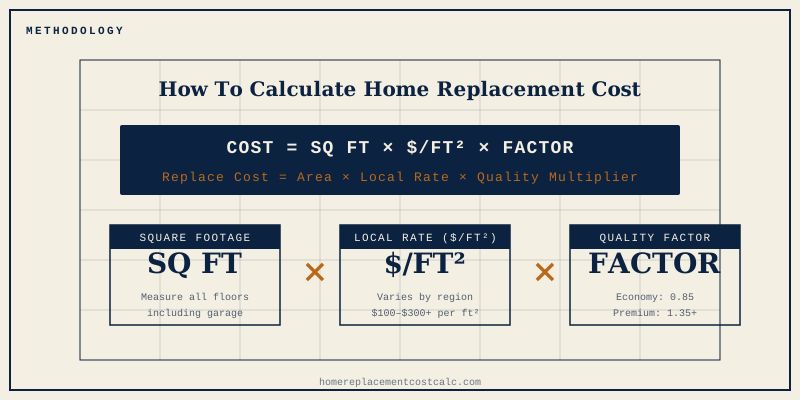
Replacement Cost = (Base Cost × Quality × Stories × Location × Sq Ft) + (Garage Cost × Location)
Example: 2,400 sq ft Masonry, Good Quality, 2-Story, Attached 2-Car, Northeast (1.4×)
- —Base: $210 × 1.25 × 1.15 × 1.4 = $422.93/sq ft
- —Dwelling: $422.93 × 2,400 = $1,015,000
- —Garage: $28,000 × 1.4 = $39,200
- —Total Replacement Cost: $1,054,200
- —Recommended Coverage (110%): $1,159,620
Skip the manual math. Use our home replacement cost calculator to get this result in under a minute.
The 110% Coverage Rule
The industry standard recommendation is to insure for 110% of your calculated replacement cost. This buffer exists for three reasons:
1. Inflation during reconstruction: Rebuilding after a major loss typically takes 18–36 months. Costs rise during that window.
2. Code upgrades: Local building codes change over time. Your rebuilt home must meet current codes, which can add 5–15% in cost (think: updated electrical panels, insulation standards, accessibility requirements).
3. Contractor surge pricing: After widespread disasters, contractor rates increase. The buffer protects you from this.
Some carriers offer a guaranteed replacement cost endorsement that removes the limit entirely. It's worth asking about if you have an older or unusual home where replacement cost is hard to estimate.
When to Recalculate
- —Annually, at policy renewal
- —After any major renovation (kitchen, bathrooms, addition, roof replacement)
- —After a significant change in local construction costs
- —When construction costs in your region have risen more than 10% since your last update
The Insurance Information Institute and most insurance professionals recommend an annual check. Given the volatility of construction costs since 2020, this is especially important right now.
Run your calculation now with our replacement cost calculator. Then compare the result to the dwelling limit on your current policy. If there's a gap of more than 10%, it's time to call your agent. You can also read about what affects replacement cost most and how to update your coverage for next steps.