How Your Garage Affects Home Replacement Cost and Insurance
An attached 2-car garage adds $28,000–$50,000 to your home's replacement cost depending on location. Here's how to account for garage value in your insurance coverage.
Quick Answer
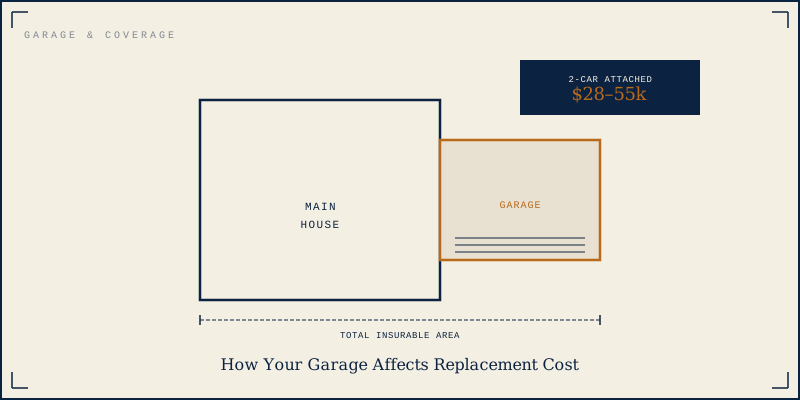
A standard attached 2-car garage adds $28,000 to the national average replacement cost estimate before your location factor is applied. In high-cost markets, the same garage can cost $40,000–$55,000 to rebuild. Garage square footage should never be included in your home's living area. It's always calculated separately.
Why Garages Get Their Own Line Item
When calculating home replacement cost, garages are treated separately from living space for a simple reason: they cost significantly less per square foot to build than heated and cooled interior space. A garage has no insulation, no finished walls, no plumbing, no HVAC, and minimal electrical. The cost drivers are just the concrete slab, framing, siding, and the garage door system.
Including your garage square footage in your main living area total would overstate your replacement cost. Excluding it entirely would understate it. The right approach, which our home replacement cost calculator uses, is to select your garage type separately and add a fixed cost estimate for that configuration.
Garage Replacement Costs by Type
These figures represent 2026 national average estimates before the regional location factor is applied.
| Garage Type | Replacement Cost |
|---|---|
| No Garage | $0 |
| Attached 1-Car | $15,000 |
| Attached 2-Car | $28,000 |
| Attached 3-Car | $40,000 |
| Detached Garage | $24,000 |
Apply your regional location factor to these costs the same way you apply it to the dwelling. In a high-cost area (1.8× California metro), an attached 2-car garage costs approximately $50,400 to rebuild. In a rural low-cost area (0.75×), the same garage costs approximately $21,000.
Attached vs. Detached: The Insurance Difference
For attached garages, the structure is physically connected to your home. In most HO-3 policies, the attached garage is covered under your dwelling coverage (Coverage A), the same limit that covers your main home structure.
Detached garages are a different story. They're covered under other structures coverage (Coverage B), which is typically set at 10% of your dwelling limit. If your dwelling coverage (Coverage A) is $400,000, you have $40,000 of Coverage B for your detached garage and any other detached structures (fences, sheds, workshops, guest houses).
This creates a common underinsurance problem: a detached garage that costs $24,000 (×1.4 location = $33,600) to rebuild, but Coverage B is only $25,000 on a modest policy. If the detached garage burns down, you have a gap.
Solution: Ask your agent whether your Coverage B limit is adequate to cover all detached structures. If you have a detached garage plus a fence plus a storage shed, the 10% default may not be enough. Most insurers will increase Coverage B for a small additional premium.
What's Actually Covered in a Garage Rebuild
When an insurer pays to rebuild a destroyed garage, the covered costs include:
- —Foundation / slab: $3,000–$8,000 depending on size and soil
- —Framing: $6,000–$15,000 depending on size
- —Siding and roofing: $4,000–$12,000 depending on material choice
- —Garage door system: $1,500–$4,000 per bay for standard doors; $3,000–$8,000 for premium insulated doors
- —Electrical: $2,000–$4,000 for basic lighting and a few outlets
- —Contractor O&P (18%): Adds 18% to the above costs
A basic 2-car attached garage comes in at $18,000–$25,000 in direct costs, plus $3,000–$5,000 in contractor overhead, landing in the $22,000–$30,000 range, consistent with the $28,000 estimate used in the calculator.
Garage Square Footage: A Common Calculation Error
The most common garage-related mistake in replacement cost calculations is including garage square footage in the home's living area total.
Here's why it matters: say your home is 1,800 sq ft of finished living space with an attached 2-car garage of 480 sq ft. Your home's total square footage including the garage is 2,280 sq ft. But if you enter 2,280 into the living area field and then also select "Attached 2-Car" garage, you've double-counted the garage.
The correct approach:
- —Enter 1,800 in the square footage field (finished living area only)
- —Select Attached 2-Car from the garage dropdown
The calculator adds the garage cost separately as a fixed dollar amount, preventing double-counting.
To find your correct finished living area, use your home's appraisal report, your county assessor's records, or measure heated and cooled rooms directly. Do not use the total area number from real estate listings, since those often include the garage.
Workshop Garages and Above-Garage Living Space
Two special cases worth addressing:
Workshop garages with upgrades: If your garage has been upgraded with spray foam insulation, finished drywall, in-floor heat, plumbing (utility sink, bathroom), or a mini-split HVAC system, it costs more to rebuild than a standard unfinished garage. In this case, the fixed-cost estimate in the calculator may understate your actual replacement cost. Consider adding $5,000–$20,000 to your total to account for these upgrades, and mention them to your insurer.
Above-garage living space: If your garage has a finished room above it (a guest suite, in-law apartment, home office, or playroom), that square footage is living space, not garage space. Include it in your finished living area total. The room above the garage is heated, cooled, and finished; it costs just as much per square foot to rebuild as any other room in the house.
Carports: Not the Same as Garages
A carport (an open-sided shade structure without full walls or a door) is typically classified as a "detached structure" or "open structure" and costs $3,000–$10,000 to rebuild. It's not equivalent to a garage and should not be selected from the garage dropdown. Most insurers cover carports under Coverage B (other structures).
If you have a carport and want to verify your coverage, ask your agent how it's classified in your policy and whether the Coverage B limit is adequate.
Checking Your Garage Coverage Right Now
1. Find your declarations page. Look at Coverage A (dwelling) and Coverage B (other structures).
2. If your garage is attached, it's under Coverage A. Check that your total Coverage A limit reflects both your home and attached garage.
3. If you have a detached garage or other structures, check that Coverage B (typically 10% of Coverage A) is enough to cover all of them.
4. Run your replacement cost estimate with your correct living area and garage type. If the result is higher than your current dwelling limit, it's time to update.
Garages are easy to overlook, but a 2-car attached garage represents $28,000–$55,000 in replacement value depending on your location. Make sure it's accounted for in your coverage. Calculate your full replacement cost including garage, and read our complete coverage update guide if you find a gap.