DIY Home Assessment vs. Professional Appraisal: Which Do You Need?
For most homeowners, a DIY replacement cost estimate using industry-standard data is sufficient. For complex or high-value properties, a professional appraisal is worth $400. Here's how to decide.
Quick Answer
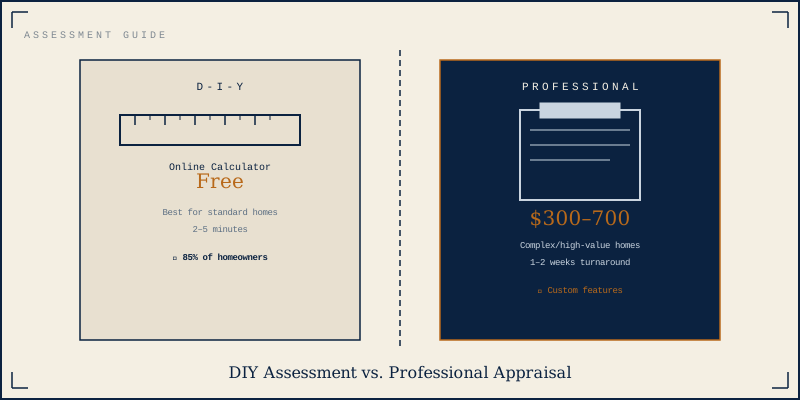
A DIY replacement cost estimate (like our calculator) is sufficient for most standard homes when the purpose is verifying insurance coverage. A professional residential appraisal is worth getting for homes over $1 million, properties with unusual construction or custom features, and any situation where you're disputing an insurer's valuation.
Two Ways to Know What Your Home Costs to Rebuild
When you want to know your home's replacement cost for insurance purposes, you have two paths:
Path 1, DIY: Use an online calculator built on industry-standard cost data (Marshall & Swift, RS Means) to estimate replacement cost based on your home's key characteristics. Takes 2 minutes. Costs nothing. Accurate within 10–15% for most standard homes.
Path 2, Professional Appraisal: Hire a Certified Residential Appraiser (CRA) or a specialized insurance replacement cost appraiser to physically inspect your home and produce a formal written replacement cost estimate. Takes 1–2 hours (inspection) plus 3–7 days for the report. Costs $300–$600. Accurate within 5–8% for complex properties.
The question isn't which method is "better" in the abstract. It's which is appropriate for your specific situation.
When a DIY Calculator Is Sufficient
For the majority of homeowners, a quality online calculator is the right tool. Specifically:
Standard residential construction: If your home uses conventional wood-frame construction with typical finishes (the kind of home that makes up 85% of American housing stock), the cost data in our replacement cost calculator is directly applicable. The inputs (square footage, construction type, quality grade, location) capture the primary cost drivers accurately.
Policy review at annual renewal: If you're simply verifying that your current dwelling limit is in the right ballpark before your renewal, a DIY estimate is exactly what you need. You're looking for a number accurate within 10%, not an appraisal-grade document.
Comparison shopping for insurance: When you're getting quotes from multiple insurers, a DIY estimate gives you a baseline to evaluate the dwelling limits each carrier suggests. If one carrier's suggested limit is 30% below your estimate, that's a flag worth discussing before you bind.
Budget planning for renovation-related coverage updates: After a kitchen renovation or room addition, a quick DIY estimate tells you how much your replacement cost has increased and how much to ask your insurer to add to your limit.
For these scenarios, spend 2 minutes with our home replacement cost calculator and you'll have what you need.
When to Hire a Professional Appraiser
Some situations genuinely require the expertise of a trained professional. Here's when it's worth spending $300–$600.
High-value custom homes (replacement cost over $1 million). Custom construction doesn't fit neatly into standard cost databases. When a kitchen costs $150,000 or the flooring throughout is hand-painted Italian tile, the inputs that drive standard calculators can't fully capture the cost. A professional who physically inspects the home and itemizes finishes will produce a more accurate estimate. The cost of the appraisal is trivial relative to the coverage amount.
Unusual construction types or historic homes. Log homes built with custom hand-hewn logs, stone masonry homes, historic Victorian homes with original plaster, moldings, and millwork, adobe construction, earth-bermed homes: these all require specialized cost knowledge that general databases may not capture well. A professional appraiser with experience in the specific construction type is worth the fee.
Post-loss disputes with your insurer. If your insurer has settled your claim and you believe their replacement cost estimate is too low, a professional appraisal from an independent third party gives you documentary evidence for the dispute process. Most insurance policies include an appraisal clause that allows this.
Lender requirements for specialty properties. Some lenders require a formal written appraisal of replacement cost for high-value or unusual properties as a condition of the mortgage.
Estate planning and divorce proceedings. If replacement cost is being used for asset valuation in a legal proceeding, you want a defensible professional document, not a calculator output.
Understanding What Professionals Look At
When a Certified Residential Appraiser or insurance replacement cost specialist visits your home, they're documenting:
1. Square footage. They measure every room, calculating gross living area, unfinished areas, and attached structures separately.
2. Construction type and materials. They note framing, exterior cladding, roofing material, and foundation type.
3. Finish quality. They photograph and describe flooring, cabinetry, countertops, fixtures, windows, and millwork. They note custom features.
4. Mechanical systems. They record HVAC type, capacity, and efficiency; electrical service size; plumbing fixtures and water heater type.
5. Special features. Pool, elevator, wine cellar, home theater, guest house, workshop, solar panels.
6. Current local cost data. Professional appraisers use current RS Means or Marshall & Swift data for your specific market.
The result is a multi-page written report with photos, measurements, and a formal replacement cost conclusion. This document can be used with your insurer, a lender, or in legal proceedings.
The Middle Ground: Your Insurer's Own Estimator
There's actually a third path that many homeowners overlook: ask your insurance company to show you their own replacement cost estimate.
Most carriers use proprietary tools (Verisk's 360Value or CoreLogic's RCT Express are the two most common) that generate replacement cost estimates based on your policy application inputs. These tools are calibrated to your specific ZIP code and use current construction cost data.
The catch: the accuracy of the carrier's estimate depends on the accuracy of the inputs you provided when you applied. If you entered "standard" quality when your home is actually "good," their estimate is too low, and your suggested dwelling limit is too low.
Ask your agent: "What is your tool showing as my estimated replacement cost, and what inputs is it using?" This is a reasonable question, and any agent should be able to answer it.
A Combined Approach for Most Homeowners
Here's a practical three-step approach that works for the vast majority of standard homes:
Step 1: Run our home replacement cost calculator using accurate inputs. This gives you a baseline estimate you can use in any conversation.
Step 2: Ask your insurer to share their replacement cost estimate and compare it to yours. If the numbers are within 10%, you're in good shape. If they differ by more than 15%, investigate why. One of you is using different inputs.
Step 3: If your home is custom, over $1 million in replacement cost, or you're disputing a claim, hire a professional. The fee is typically $300–$600 and is usually reimbursable under your policy's appraisal clause (check with your agent).
Finding a Qualified Appraiser
For insurance replacement cost appraisals specifically, look for:
- —Certified Residential Appraiser (CRA) designation from the American Society of Farm Managers and Rural Appraisers
- —Member of the Appraisal Institute (MAI) for high-value residential properties
- —IRS designation for historic properties (if your home qualifies as historic)
Interview two or three appraisers before hiring. Ask specifically about their experience with replacement cost appraisals (not just market value appraisals, since these are different skills), and ask how they source their cost data.
For most homeowners, running a DIY estimate followed by a quick comparison with your current policy is all you need. If you find a gap, read our insurance coverage update guide for exactly what to do next. And if your home is complex or high-value, get a professional appraisal. It's one of the most cost-effective ways to protect a major asset.